
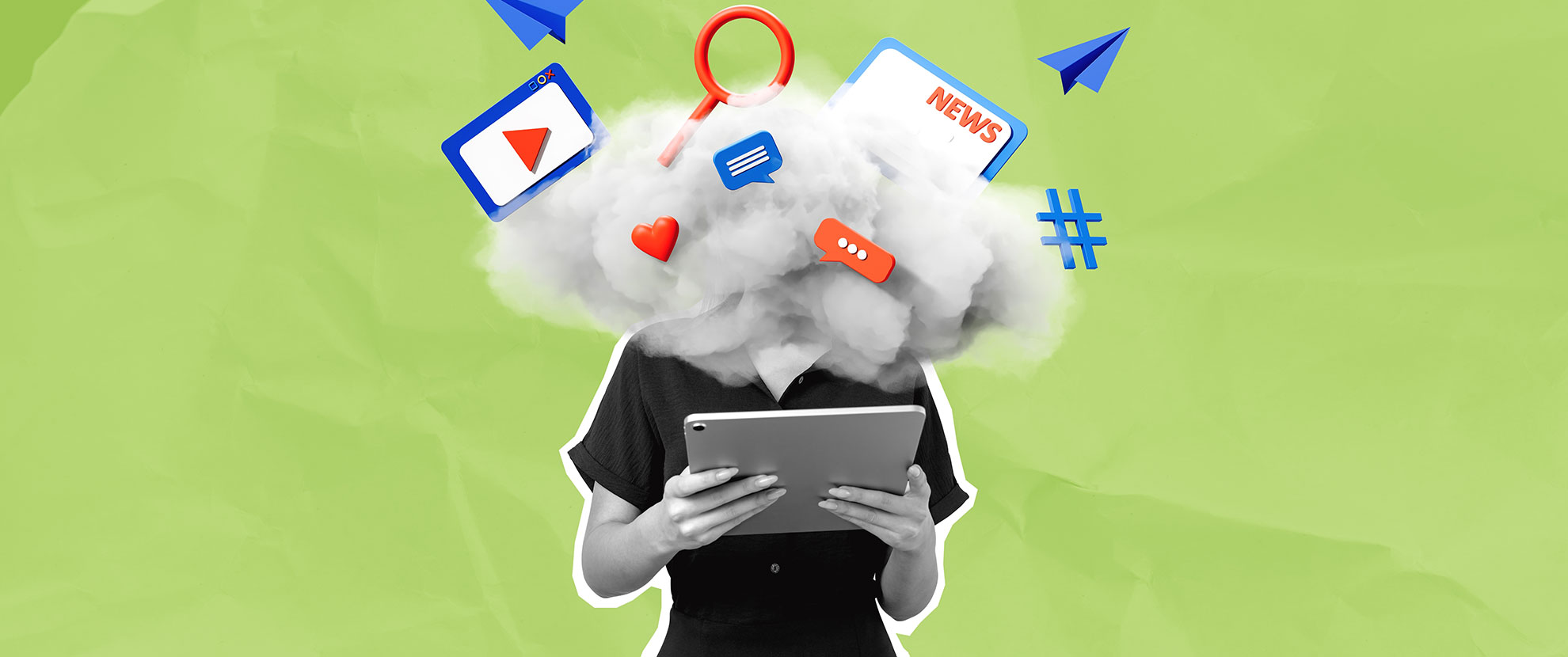
You set out to finally complete that one block today: concept finished, proposal sent, slides polished, mind clear. You open the document, and even before you’ve rephrased the first sentence, what has become so normal that we no longer even call it a ‘disruption’ happens: a message, a comment, a ‘Do you have a moment?’, a meeting reminder that isn’t really one, because there was no invitation, just a link in the chat. One could say: Welcome to everyday life. One could also say: Welcome to the new primary activity of many knowledge workers – the administration of communication.
The fact that work today feels ‘chaotic’ and ‘fragmented’ is not (only) a feeling. In a WorkLab report, Microsoft described, using Microsoft 365 telemetry, how the day begins long before the day itself: Many are already online at 6 AM, and 40% of those active at that time check emails to somehow sort out their day. At the same time, the average person receives 117 emails per day – most are skimmed in less than a minute.
The problem is not that emails exist.
The problem is that for many, the inbox has become an improvised control center: it contains priorities, tasks, guilt, escalations, and the vague hope that a plan will somehow distill itself from the stream. And when we ‘really get started’ around 8 AM, the day shifts to the next channel: Teams takes over. On average, 153 Teams messages are added per workday.
These numbers can be read like weather data: interesting, but somehow beyond one’s control. Until you read the sentence that feels like a diagnosis. Microsoft writes that employees are interrupted every two minutes on average during core working hours – by meetings, emails, or notifications. And for those particularly ‘pinged’ individuals (top 20% by ping volume), this adds up to 275 interruptions per day.
Every two minutes. This is not a productivity problem. This is a miracle of attention if anything profound is still created.
Alignment seems cheaper than decision-making
Now one might say: ‘Then just turn off notifications.’ That’s the classic individual response to a systemic problem. And yes: notifications off is better than notifications on. But it doesn’t solve the core issue, because the core isn’t in the icon, but in how we organize collaboration. We’ve treated communication like confetti: the more, the safer. Better to CC everyone, better to have another meeting, better to ‘quickly align’ again, because alignment seems cheaper than decision-making.
Microsoft describes this in an observation that many teams know uncomfortably well: 57% of meetings are ad hoc – without a calendar invitation – and one in ten planned meetings is scheduled at the last minute. At the same time, precisely the most valuable hours are filled with calls: half of all meetings occur between 9-11 AM and 1-3 PM, exactly when many people could naturally experience a peak in performance if they were allowed to.
And then we wonder why ‘Deep Work’ sounds like a wellness concept: nice, certainly healthy, but in everyday life about as realistic as a nap in an open-plan office.
The second part of the problem is less visible but more brutal: the cognitive cost of switching. Constantly jumping not only wastes time but also mental energy. A Microsoft Research paper states that people take an average of about 23 minutes to fully re-engage with a task after an interruption. And older research by Gloria Mark and colleagues shows that while interruptions can sometimes lead to ‘more speed,’ they also lead to more stress, time pressure, and mental strain.
This is important because it exposes the usual self-deception: ‘I’m just good at multitasking.’ Multitasking is often just the elegant name for not truly arriving anywhere.
Meetings play a special role here because, unlike emails, they carry social weight. A meeting is not just ‘time’; it’s also an expectation: presence, reaction, agreement, participation. Harvard Business Review cites research showing that about 70% of all meetings prevent employees from working productively and completing tasks.
And here too: the problem is not meetings themselves. The problem is meetings as a default solution for uncertainty.
The day has no boundaries anymore
If you put all this together, something emerges that Microsoft calls the ‘infinite workday’: The day has no boundaries anymore. Meetings after 8 PM are increasing (up 16% year-over-year), and at 10 PM, almost a third of active people check their inbox again – as if the night is where one finds the peace that the day no longer provides.
It’s the professional equivalent of having to assemble your bicycle before every bike ride. You’re constantly busy, but often just with creating the prerequisites for the actual work.
What helps? Not the next app rollout, nor the moral sermon ‘you need to be more focused.’ What helps is a decision that sounds almost boring but is astonishingly rarely truly made: We design communication as a system.
This doesn’t start with a 30-page rulebook, but with a simple question: What is each channel for? As soon as a team seriously clarifies this, something magical happens: chat loses its claim to be an archive. Email loses its role as a task list. Meetings regain a justification for existence that goes beyond ‘we are uncertain.’ And suddenly, you can say things like: ‘That’s not a meeting question. That’s a document question.’ Or: ‘That’s not a chat question. That’s a decision.’ This change in language alone is already organizational development.
The second thing that helps is a small dose of courage for asynchronous communication. Many status meetings are, in reality, ritualized information transfer. And information transfer is the worst justification for an hour of sitting together when it could also work as a short update post. Those who establish asynchronous updates quickly realize: it doesn’t mean less work – but it means more work that is truly work, instead of coordination about coordination.
The third is a kind of new courtesy: ‘No Agenda, No Meeting.’ Not as a display of power, but as respect. An agenda doesn’t have to be pretty. It just has to state: What should be different after this conversation? If that’s not clear, the meeting is often not yet ready, or it’s actually a document.
And then there are the unspectacular adjustment screws that are underestimated until consistently used: planning shorter meetings (to create breathing room), protecting focus times as a team norm (not an individual wish), offering office hours instead of constant interruptions, documenting decisions in a concise log so you don’t start from scratch every week. These are not productivity tricks. These are cultural decisions: We show each other that attention is a resource, not an all-you-can-eat buffet.
Of course, the AI question often comes up at this point: ‘Can AI solve all this?’ Microsoft puts it very aptly in its report: AI can be a way out, but if you put it on a broken system, it only accelerates the brokenness.
Those who use AI to produce even more emails gain no productivity, but more text. Those who use AI to bundle threads, clarify decision statuses, and reduce noise, on the other hand, gain exactly what we need most today: working time that looks like work again.
Ultimately, communication overload is not a matter of discipline. It is the symptom of a system that we have fed with ‘more alignment’ for years. And the good news is: systems can be designed. Not perfectly. But noticeably. And sometimes, all it takes is one team that has decided that focus is not a luxury, but a prerequisite.
If you want to look at Microsoft’s numbers yourself, you can do so here:
https://www.microsoft.com/en-us/worklab/work-trend-index/breaking-down-infinite-workday


